
TWO: The Repeal Agitation¡ªDebate in the Dublin Corporation¡ªThe Monster Meetings¡ªO'Connell's Speech at Tara¡ªThe Arms Bill¡ªDismissal of the Repeal Magistrates¡ªSpeeches of the Duke of Wellington¡ªThe Arms Bill becomes Law¡ªProclamation of the Clontarf Meeting¡ªO'Connell's Counter-Proclamation¡ªArrest and Trial of O'Connell¡ªThe Sentence¡ªIt is reversed by the House of Lords¡ªRejoicings on O'Connell's Liberation¡ªThe Excitement at Cork¡ªDecline of O'Connell¡ªHis Breach with the Young Ireland Party¡ªIrish Debates in Parliament¡ªApproach of the Irish Famine¡ªThe Devon Commission¡ªIts Report¡ªArrival of the Potato Disease¡ªThe Famine¡ªThe Relief Committee of the Society of Friends¡ªThe Famine in Ulster¡ªA Description of Cork and Skibbereen¡ªDemoralisation of the Population¡ªPolicy of the Whig Cabinet¡ªLord George Bentinck's Railway Plan¡ªFailure of the new Poor Law and of the Public Works¡ªThe Temporary Relief Act¡ªFather Mathew¡ªPrivate Benevolence¡ªMunificence of the United States.These enactments, unaccompanied by any others the object of which was to relieve the distress of the people, only tended still more to exasperate the feelings of the working classes. In fact, nothing had been so obvious as the effect of the proceedings of Government of late in disturbing that peace which they professed themselves so desirous to preserve. They, in truth, were the real agitators. The passing of the Six Acts only made the popular resentment the deeper, and whilst this tended to render the more prudent Reformers cautious, it stimulated the lowest and most unprincipled of them to actual and deadly conspiracy. The general conspiracy believed in by Ministers never existed, but a conspiracy was actually on foot in London, which again was found to have been, if not originally excited, yet actively stimulated, by the agents of Government. The details of this transaction, and of the concluding scene of the Manchester outrage, namely, the trial of Hunt and his associates, necessarily lead us about two months beyond the death of George III., which took place on the 29th of January, 1820. In November, 1819, whilst Government were framing their Six Acts, the more completely to coerce the people, they were again sending amongst them incendiaries to urge them to an open breach of the laws in order to furnish justifications for their despotic policy. The leading miscreant of this class was a man named Edwards, who kept a small shop at Eton for the sale of plaster casts. Some of the emissaries appeared at Middleton, the place of Bamford's abode, but he was in prison awaiting his trial with Hunt and the rest, and the people tempted were too cautious to listen to these agents of Government. But in London these agents found more combustible materials, and succeeded in leading into the snare some who had been long ready for any folly or crime. Chief amongst these was Thistlewood, who had been a lieutenant in the army, a man who had, or conceived that he had, suffered injustice at the hands[154] of Ministers, and who had wrought up his temper to the perpetration of some desperate deed. Bamford when in London, in 1816, had found Thistlewood mixed up with the Spenceans, and to be met with any day at their places of resort¡ªthe "Cock," in Grafton Street, the "Mulberry Tree," in Moorfields, the "Nag's Head," Carnaby Market, No. 8, Lumber Street, Borough, and a public-house in Spa Fields, called "Merlin's Cave." At these places they might be found, amidst clouds of tobacco-smoke and the fumes of beer, discussing remedies for the miserable condition of the people. At the latter place Thistlewood was often to be found with the Watsons, Preston, and Castles, who was employed to betray them. From this spot they issued for their mad attempt on the Tower on the 2nd of December of that year. Thistlewood was one of those seized on that occasion, but was acquitted on his trial. Not warned by this, he no sooner got abroad than he sent a challenge to Lord Sidmouth, for which he was arrested, and sentenced to a year's imprisonment. He issued from gaol still more embittered against Sidmouth and his colleagues, and resolved on striking some mortal blow at them. He did not lack comrades of a like fiery and abandoned stamp, and they determined on a scheme for cutting off the whole Cabinet together. The detestable deed was to be perpetrated in the autumn of 1819, a time when the public mind, especially that of the working classes, was so embittered against the Government. They did not, however, succeed in their intentions, and it was at this crisis of unwilling delay that the man Edwards became privy to their plans. In November he carried the important, and, as he hoped, to him profitable secret to Sir Herbert Taylor, who was attached to the establishment of the king at Windsor, and by him he was introduced to Lord Sidmouth. This minister and his colleagues, with that fondness for the employment of spies, and for fomenting sedition instead of nipping it in the bud, immediately engaged Edwards, on good pay, to lead forward the conspirators into overt action. It was not enough for them that, by adding another witness or two to Edwards, they would be able to produce the most complete proof of the treason of these men¡ªthey rather luxuriated in the nursing of this plot, and thus ripening it into something bloody and horrible; and in this they succeeded.
THREE:Windham, on the 3rd of April, proposed his plan for the improvement of the army. Till this time enlistments had been for life, which gave men a strong aversion to enter it, and made it the resort chiefly of such as were entrapped in drink, or were the offscouring of society, who became soldiers to enjoy an idle life and often to escape hanging for their desperate crimes. He said that we could not have recourse to conscription in this country, and to get men, and especially a better class of men, we must limit the term of service and increase the pay. To prepare the way for his contemplated regulations, he first moved for the repeal of Pitt's Additional Force Bill. This was strongly opposed by Castlereagh and Canning, who contended that nothing could be better or more flourishing than the condition of the army; and that the repeal of Pitt's Bill was only meant to cast a slur on his memory. Notwithstanding this,[519] the Bill was repealed by a majority, in the Commons, of two hundred and thirty-five against one hundred and nineteen, and in the Lords by a majority of ninety-seven against forty. Windham then moved for a clause in the annual Mutiny Bill, on the 30th of May, for limiting the terms of service. In the infantry, these terms were divided into three, of seven years each; and in the cavalry and artillery three also, the first of ten, the second of six, and the third of five years. At the end of any one of these terms, the soldier could demand his discharge, but his privileges and pensions were to be increased according to the length of his service. Notwithstanding active opposition, the clause was adopted and inserted. He then followed this success by a series of Bills: one for training a certain number of persons liable to be drawn from the militia, not exceeding two hundred thousand; a Bill suspending the ballot for the militia for England for two years, except so far as should be necessary to supply vacancies in any corps fallen below its quota; a Bill, called the Chelsea Hospital Bill, to secure to disabled or discharged soldiers their rightful pensions; a Bill for augmenting the pay of infantry officers of the regular line; and one for settling the relative rank of officers of troops of the line, militia, and yeomanry. To these Bills, which were all passed, was added a vote for the increased pay of sergeants, corporals, and privates of the line, and an augmentation of the Chelsea pensions, and the pensions of officers' widows. Lord Howick moved that the same benefits should be extended to the officers, petty officers, and seamen of the navy, and to the Greenwich pensioners, which was carried. These were, undoubtedly, most substantial measures of justice to the two services; and the results of them soon became apparent enough in their beneficial effects on the condition of the army and navy.
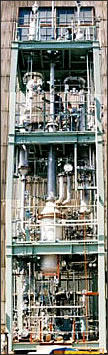
High quality is being demanded in many fields nowadays and so in order to satisfy that we developed a high-purity distillation system in collaboration with Ube industries, Ltd. and Kanto Chemical Co., Inc. The system is used to refine cleaning solutions for the semiconductor industry, medical materials, etc. of high purity (residual ion concentration: 0.01 to 1.0 ppb).
- Our High-purity distillation system provide our clients with high solvent recovery rate, almost 100%.
- The quality of the products/output from our system is very stable, which makes production management very easy, and easier than the conventional ion exchange resin method.
- No emission of waste brings our clients reduction of running cost for environmental measures.
- Our various devices minimize entrainment.
- To prevent the elution of metal, you could ask us the system made of Teflon.
- Our High-purity distillation system has been already proved for solvents that trigger very rapid decomposition reactions, such as hydrogen peroxide.
- Product guide
- Alcohol distillation
- Distillation equipment
- High-purity distillation system
- Membrane separation type solvent dehydration system
- Reactor
- Evaporative concentration equipment
- Coulter spray dryer
- Microwave treatment system
- Filter dryer
- OS filter (continuous vacuum rotating filter)
- Hydrocyclone (liquid cyclone)
- Thermal oil heater (heat medium boiler)
- Process air heater (air heater)
- Ammonia treatment system
- Catalytic deodorizing equipment for ammonia and VOC gas
- Stationary cryogenic storage tank
- Portable cryogenic container
- Cryogenic liquefied gas evaporator